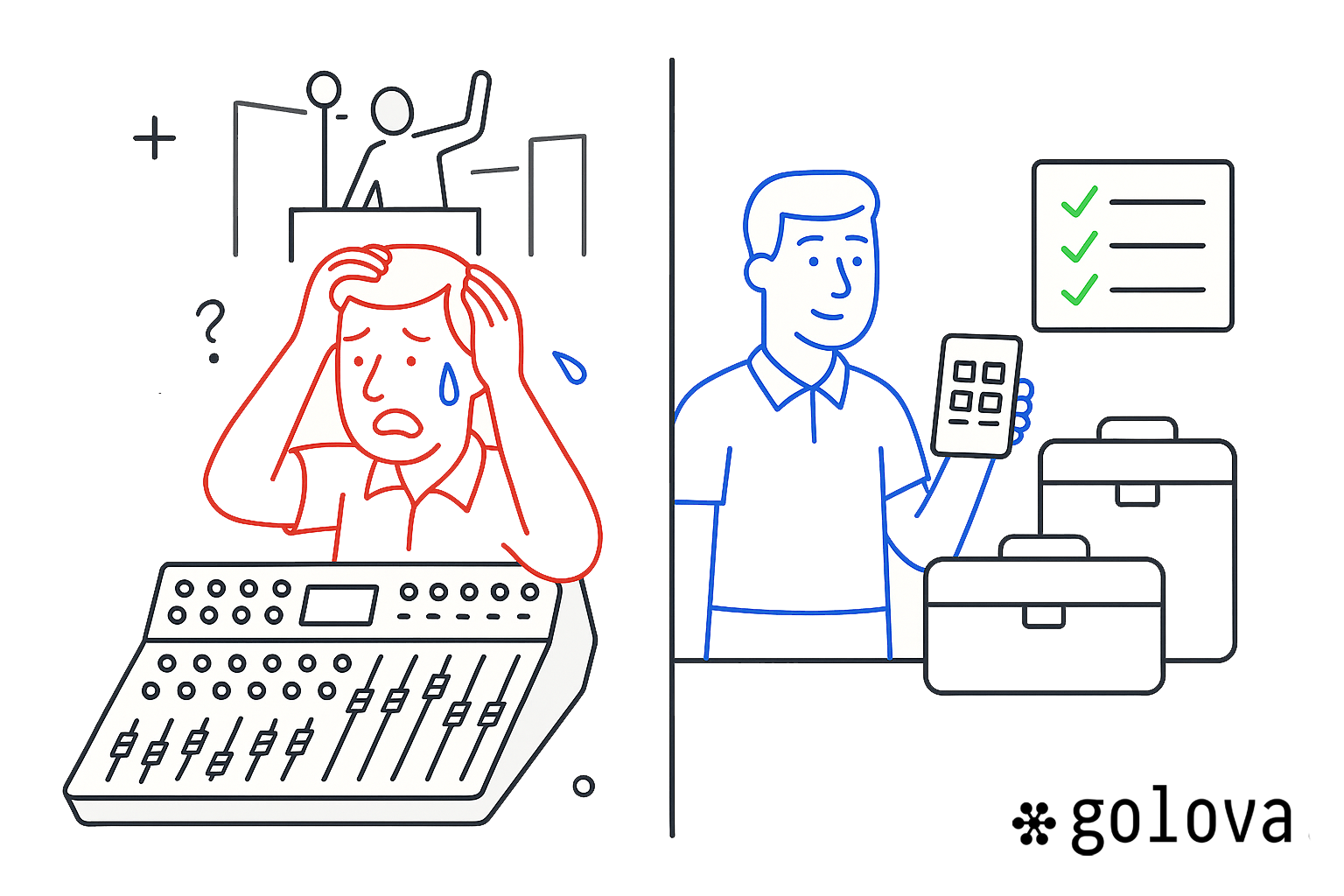
Soundcheck in 10 minutes. The console doesn’t work.
A familiar scenario: the event is done, the gear is back at the warehouse. Everything seems fine, no one complains. The equipment — including the mixing console — goes back on the shelf. A few days later, it’s shipped out again for another show, another client.
And that’s when things suddenly go wrong.
One of the channels is dead.
Or a fader’s stuck.
Or the console won’t even turn on.
The stage is set, the soundcheck window is brutally tight — and the main desk is down.
Panic kicks in:
“Is there anyone at HQ who can bring a spare?”
“Will they make it through traffic?”
“If everyone’s already here — how long will it take to go there and back?”
Meanwhile, the artists are already on site. Their crews and sound engineers are furious. Everyone’s waiting.
And if there’s no suitable replacement at the warehouse? Then it’s either quickly rebuilding the setup — cutting channels, dropping monitor lines, rewiring everything on the fly — or scrambling for an urgent subrental. And with technical riders, it’s not just “any mixer will do” — specific brands and models are often non-negotiable. Any alternative might get rejected on the spot.
Sometimes, you have to rework the entire system from scratch. Live. Under pressure. No time, no margin for error.
One delay — and you’ve blown the schedule. Or worse — the entire event.
And all of this madness because no one noticed or logged the issue when the console came back from the previous project.
In Golova, this gets resolved right at the return stage.
If the console is clearly faulty, the technician can immediately mark it as broken, add a comment like:
“won’t power on”,
“channel 3 drops”,
“fader 5 sticks”.
The system will automatically remove the item from all future bookings — it’s off the roster until fixed.
If the issue isn’t confirmed but there’s suspicion, the gear can be manually marked in the catalog as “Needs diagnostics”. That way, nothing slips through the cracks.
The result? Fewer failures, less stress.
The team knows the equipment they get for a show has been checked and cleared.
And problem gear stays off the stage — until it’s truly ready.